TLDR
- Spaced repetition reviews each concept just before you would forget it, so retention compounds instead of decaying — the fix for the "studied Polity, forgot it three weeks later" problem.
- Every question you get wrong in practice or a mock auto-enrolls into your review queue. No manual flashcard creation, no decks to maintain.
- The SM-2 algorithm schedules each card by your recall rating: easy answers stretch the interval (1 -> 3 -> 7 -> 16+ days), hard ones reset it to a day so weak topics resurface more often.
- A 20-card daily cap keeps reviews to ~15-20 minutes, and the red badge on your home nav always shows how many are due.
The Forgetting Problem in Competitive Exam Prep
You study Polity for two weeks, move on to Economy, and three weeks later you've forgotten half the Polity you knew. That's not a discipline problem — it's a spacing problem. Spaced repetition is the fix.
How Wrong Answers Auto-Enroll
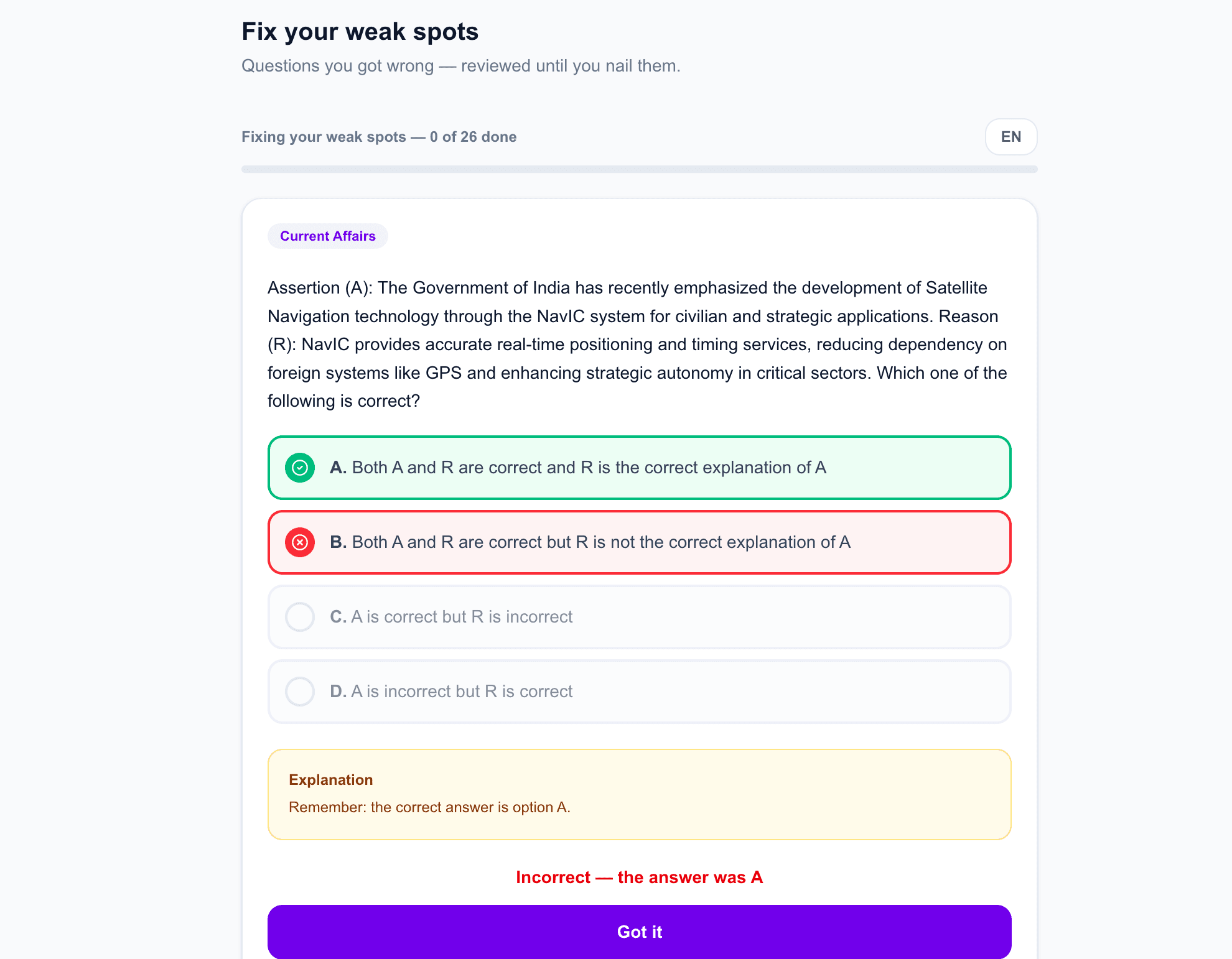
Every question you get wrong in a practice session or mock is automatically enrolled into your review queue. No manual flashcard creation. The system picks it up and schedules the first review within 1 day.
The SM-2 Algorithm
SM-2 is the proven spaced repetition algorithm. After you review a card and rate your recall (easy / ok / hard), it calculates when to show it next. Nail it twice in a row → longer interval. Struggle → shorter interval. Over time, hard concepts get reviewed more often; easy ones fade to monthly.
How the Review Schedule Works
A review card moves through the queue in a fixed loop. Each time it comes due, you answer it, rate your recall, and the algorithm decides the next gap. Here is the full cycle, step by step.
The SM-2 review loop, step by step
- 1You answer a question wrong in a practice session or mock. It is auto-enrolled as a review card with a starting ease factor of 2.5 and a first interval of 1 day.
- 2One day later the card surfaces in your review queue. You attempt it again and rate your recall: hard, ok, or easy.
- 3If you recall it (ok or easy), the interval grows — typically to about 3 days on the second success, then roughly 7, then ~16, then a month-plus as the gap multiplies by the card's ease factor.
- 4If you fail it (hard / wrong), the interval resets to 1 day and the ease factor drops, so a stubborn concept comes back tomorrow instead of next week.
- 5Each success nudges the ease factor up and each lapse nudges it down, so the schedule self-tunes to how well you actually know that specific concept.
- 6Easy, well-known cards drift out to monthly reviews; hard concepts stay on a short leash. Your daily queue stays small (capped at 20) while still covering everything at risk of fading.
| Review # | You rate recall | Interval before next review | What it means |
|---|---|---|---|
| 1st (enrolment) | — (wrong in practice) | 1 day | Card enters the queue; sees you again tomorrow |
| 2nd | ok / easy | ~3 days | First successful recall; gap opens up |
| 3rd | ok / easy | ~7 days | Weekly cadence; concept is sticking |
| 4th | ok / easy | ~16 days | Roughly bi-weekly; low-risk now |
| 5th+ | easy | 1 month+ | Long-term memory; rare maintenance reviews |
| Any review | hard / wrong | Resets to 1 day | Interval collapses; card resurfaces tomorrow |
A worked example: Riya's Polity cards
Meet Riya, a state-PSC aspirant who sits a full-length mock and gets 12 Polity questions wrong — fundamental rights, the amendment process, and a couple on centre-state relations. All 12 auto-enrol as review cards that evening; nothing for her to set up. Day 1, the queue shows all 12. She nails 9 of them (rated ok/easy), so those jump to a ~3-day gap; the 3 she still fumbles reset to tomorrow. By day 3 the 9 return — she clears 8, which move out to ~7 days, while the one she misses drops back to a day. The three stubborn cards keep cycling at 1-3 day gaps until they stick. Around day 16 the easy ones resurface one last time before fading to monthly. Fast-forward to her next mock: those amendment and fundamental-rights questions are now reflexive, because she met each one again at exactly the moment she was about to forget it — total review time, a few minutes a day.
Why This Beats Re-Reading Notes
Re-reading feels productive but has weak retention. Active recall — being tested on the exact question you got wrong before — is 2–3x more effective for long-term retention. SRS forces active recall at the optimal spacing interval.
A large meta-analysis of distributed-practice research found that spacing study sessions apart produces substantially better long-term retention than massing them together — and that longer gaps tend to help, provided the gap is matched to how far away the test is.
| Dimension | Re-reading notes | Spaced repetition (SRS) |
|---|---|---|
| Mental effort | Passive — eyes skim familiar text | Active recall — you must retrieve the answer |
| Long-term retention | Weak; fades within weeks | 2-3x stronger for durable memory |
| Timing | Whenever you happen to revisit | Scheduled just before you would forget |
| Coverage of weak spots | You re-read what you already know | Surfaces exactly the questions you got wrong |
| Daily time cost | Open-ended, easy to over-spend | Capped (~20 cards, 15-20 min) |
| Setup | Re-organise notes manually | Zero — wrong answers auto-enrol |
Not sure which commission you are preparing for? Browse every supported State PSC exam and pick your target to start building a review queue.
Explore all State PSC examsEvery PYQ you get wrong auto-enrols into spaced repetition — attempt real past papers online and watch your review queue build itself.
Attempt UPPSC previous-year questions freeWhen a review card exposes a gap, jump straight to the topper-trusted notes on that topic to patch it before the next review.
Read the topper-trusted study notesSpaced repetition is one half of the equation. See how active recall makes every review count in this companion guide.
Why active recall beats passive revisionPair your daily review queue with a countdown timer and Pomodoro tracker to lock in a consistent revision habit.
Plan your revision with free study tools