Most study plans fail for the same reason: they're written once at the start and never touched again. You score 38% on Economy in Mock 2 — but your plan still has you revising Polity all week because that's what was scheduled.
PSCPrep.ai works differently. Every mock you take feeds directly back into your weekly plan. Here's exactly how it works — and why it changes outcomes.
Step 1 — The mock as a diagnostic
We don't just record your score. We dissect it.
When you finish a mock on PSCPrep.ai, we don't just show you a total score. We break your performance down by:
- Topic (Polity, History, Geography, Economy…)
- Difficulty band (easy / moderate / tough)
- Time spent per question (fast guesses vs. careful attempts)
- Accuracy trend — is this topic improving or sliding over your last 3 mocks?
This multi-dimensional breakdown is what makes adaptation possible. A single number tells you nothing. Topic-level trend data tells you exactly where to go next.
Step 2 — The adapt cycle
The loop that runs after every mock
Within minutes of submitting your mock, the AI planner runs through a four-step cycle:
The adapt cycle
Take mock
Full-length or topic test
Score analysis
Topic × difficulty breakdown
AI identifies gaps
Weak topics flagged
Plan rebuilds
Next week auto-updated
This isn't a one-time recalibration. The loop fires after every mock — whether it's a full-length test or a 20-question topic set. The more you practice, the sharper your plan gets.
Step 3 — Reading the signals
How the AI decides what needs more time
We look at three consecutive mocks for each topic, not just the latest one. A single bad mock could be a bad day. A consistent downward trend is a real gap.
| Topic | Mock 1 | Mock 2 | Mock 3 | Δ Trend | AI Action |
|---|---|---|---|---|---|
| Indian Polity | 72% | 68% | 74% | +2 | stable |
| Odisha History | 45% | 38% | 42% | -3 | needs focus |
| Geography | 80% | 83% | 87% | +7 | on track |
| Economy | 55% | 49% | 51% | -4 | needs focus |
| Science & Tech | 70% | 74% | 79% | +9 | on track |
Example: "needs focus" topics get extra sessions in the next weekly plan. "on track" topics are maintained.
The rules are simple but powerful:
- ›Δ < –5 over 2 mocks → topic marked critical, gets 2–3 extra sessions next week
- ›Δ > +8 and accuracy above 75% → topic enters "maintenance mode" (1 session, mostly PYQs)
- ›Time-per-question too high (slow and wrong) → concept sessions added before PYQ practice
- ›Time-per-question low but wrong (fast guessing) → elimination + strategy sessions added
Step 4 — The rebuilt week
What your plan actually looks like before and after
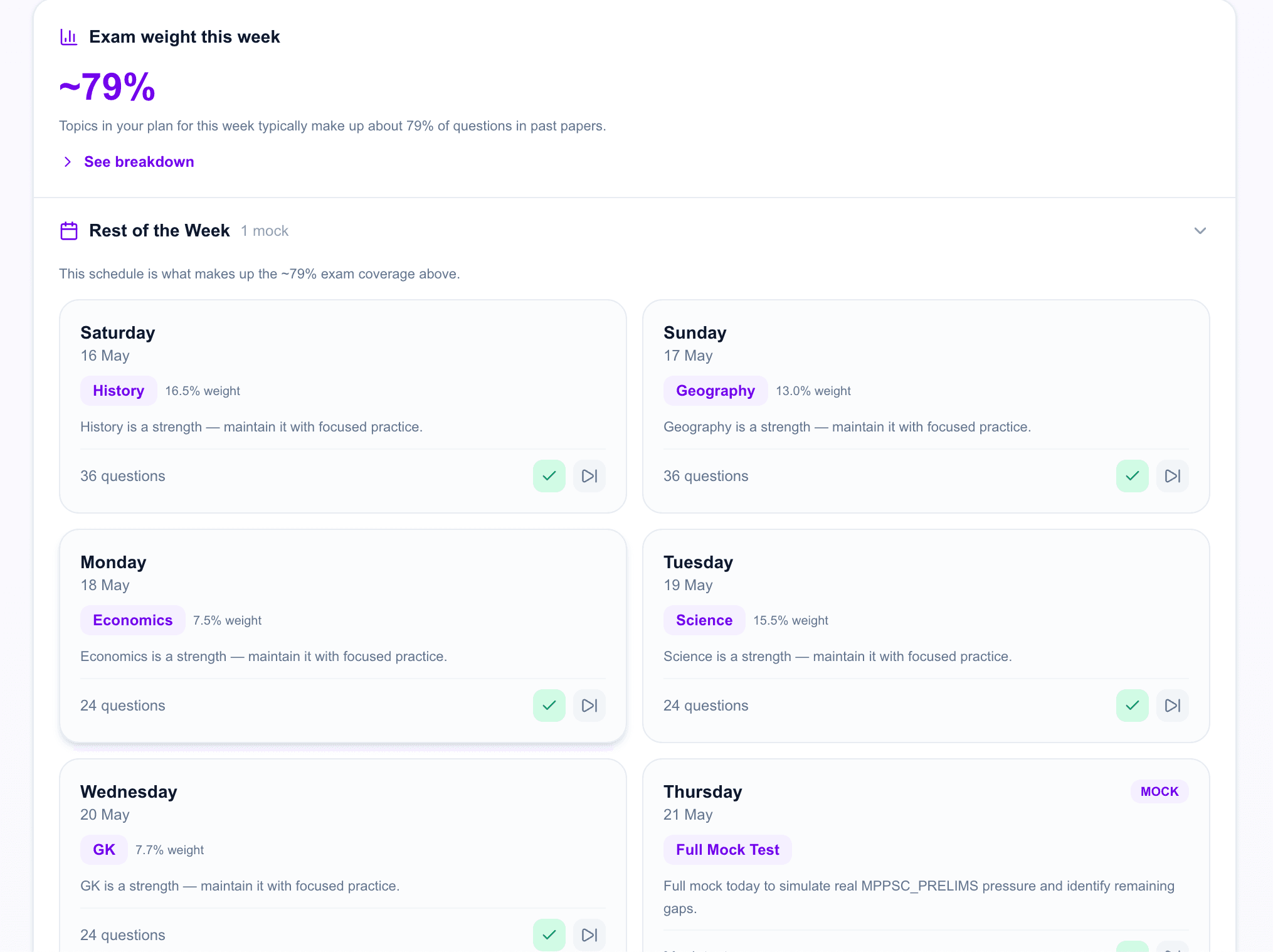
Here's a concrete example. A student took Mock 3 and scored poorly on Odisha History and Economy. Here's what changed in their Week 4 plan:
Week 3 — Before mock
Week 4 — After mock (adapted)
AI updatedPolity dropped from 2h to 1h (it's tracking well). Odisha History and Economy each got an extra day — including dedicated PYQ sessions. Saturday's full mock was replaced with a targeted topic mock covering only the two weak areas.
The bigger picture
Why this matters more than willpower
Most aspirants know they should spend more time on weak topics. The problem is that a static plan — or no plan — leaves that decision to willpower in the moment. When you've already studied for 2 hours and you have to choose between "do what's comfortable" and "revisit what hurt last week," comfort wins almost every time.
When the plan itself decidesthat Monday is Odisha History day — and that's just what's on the schedule — you don't have to make that hard choice. You just follow the plan.
That's the real advantage of adaptive planning. Not the AI. Not the algorithm. The removal of the daily micro-decision about what to study.
Key takeaways
- 1Every mock auto-triggers a plan recalibration — no manual input needed.
- 2We track 3-mock trends, not single scores, to avoid overreacting to bad days.
- 3Weak topics get extra sessions + PYQ drilling. Strong topics go into maintenance mode.
- 4The goal is to make the daily decision automatic — you follow the plan, the plan follows your data.
See it work on your scores
Take the diagnostic quiz, pick your exam, and watch the plan adapt after your first mock. Free to start.
Start free